

Cooking Classes, Dadaocheng Blog
Dadaocheng Adventure | BeMyGuest Taipei Cooking Class
Dadaocheng
Dadaocheng means: a large, wide rice drying field. In the beginning, this was an open piece of land by the river.
Starting around 170 years ago, with the development of the immigrant population from Fujian, China, Dadaocheng was once the most prosperous and bustling “city center” of Taipei.
Tamsui River
Most of the ancestors of Taiwanese people immigrated from Fujian and Guangdong in China by small boats.
In 1704, people began to cultivate Taipei.
They set out from their hometown, crossed the Taiwan Strait, arrived in Tamsui, entered Taipei along the Tamsui River, cultivated Mengjia, established Longshan Temple, and utilized the Mengjia port to trade with Xiamen and Quanzhou in Fujian.
In 1853, a ethnic conflict occurred, and a group of people migrated to Dadaocheng. A few years later, they established the Dadaocheng Wharf, replacing the original Bangka port, which led to the prosperity of Dadaocheng, making it the most bustling place in Taipei.
Dadaocheng Wharf
At dusk, Dadaocheng Wharf is a very suitable place to enjoy the scenery, where you can have coffee and snacks while admiring the most beautiful sunset in Taipei.
Taipei Bridge
It is the first bridge in Taipei, a wooden bridge completed in 1889 during the Qing Dynasty for the purpose of walking trains.
Later, due to changes in the railway route in Taipei and the many typhoons in Taiwan, the Taipei Bridge was damaged by a typhoon in the same year it was rebuilt by the Japanese government in 1920, and it was then reconstructed, completing a steel-structured iron bridge in 1925.
My Grandma’s story
I come from San Chong in New Taipei City across the river. My grandmother, when she was young, needed to walk from San Chong to Dadaocheng for work every day. At that time, there was a period without a bridge (because it was destroyed by a typhoon). My grandmother had to first walk into the water, and then after reaching a small island in the middle of the river, take a small boat to Dadaocheng. My grandmother said that the river water on the San Chong side was not deep at that time, so it was fine to walk in.
Labor Market
Because it is an important route connecting the capital Taipei with other cities, the area under the Taipei Bridge has always gathered adventurers from other cities. They gather there every day waiting for opportunities as temporary workers, which has turned the area under the Taipei Bridge into a labor market and created a bustling market around the bridge.
Ten connected buildings Shi-lian-dong
It refers to ten connected buildings. The current ten connected buildings have been renovated while preserving the original appearance at the front, and the back has been transformed into a modern building. In the early days, the ten connected buildings housed individual shops, with each shop representing a family, mostly engaged in the rice business. They transported rice brought in by boat from the dock to their homes, then used machines to remove the husk from the rice, turning it into white rice for sale in the front shops, while the other parts of the house served as their family residence.
Li Ting Xiang Bakery
In Taiwanese customs, if a family has a daughter getting married, the parents must prepare wedding cakes (Chinese pastries) to give to relatives and friends, to announce that their daughter is getting married.
However, if Li Ting Xiang is used, it represents that the family is very wealthy, as they can afford the cost of this brand-name wedding cake at that time.
These types of Chinese pastries are usually made with lard, sugar, and flour, which makes them very high in calories and not in line with modern health needs.
Therefore, Li Ting Xiang has made changes to create these pastries in a delicate form similar to small macarons, in order to cater to the preferences of the younger generation.
Fude Temple (God of Land)
The main religious belief in Taiwan is a mix of Buddhist and Taoist deities, where people may identify themselves as Buddhists or as Taoists. Buddhism originates from India, while most of the deities in Taoism are historical figures or characters from Chinese legends.
The Land God (Tu Di Gong) is a deity that Taiwanese people love very much.
Almost every place in Taiwan has large or small Land God temples.
The Land God exists like a neighborly grandfather, and people always send respect to him when passing by the temple.
The Land God mainly blesses the safety and health of the local area, and another aspect is to bless good business. Therefore, owners from stores and shops near Dihua Street almost always prepare offerings at fixed times to worship the Land God.
The Tiger God is the assistant of the Land God. He helps the Land God investigate whether the people who come to worship is a good man or not. After the investigation, the Tiger God reports back to the busy Land God, who then decides whether to bless that person.
Chicken Alley
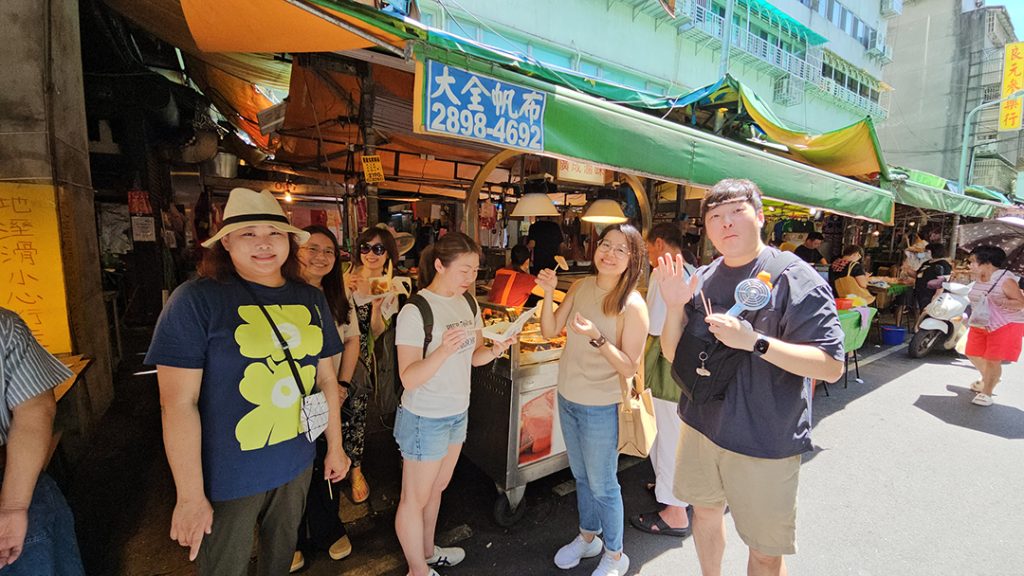
You are currently walking on the chicken alley. 40-50 years ago, both sides were lined with vendors selling chickens. Their chickens were kept in bamboo cages, and when you wanted to buy a chicken, the owner would grab one, kill it on the spot, pluck the feathers, and then let you take it home, very fresh.
Tai Ping Market
During the Japanese colonial period, one side of this road was called Eilaku Cho, and the other side was called Taihei cho.
After the Japanese defeat and departure from Taiwan, the names from that time were preserved here. But we pronounce in Mandarin.
There is Yongle Elementary School over here, and over there is Taiping Elementary School. The market we are going to today is located on the side of Taihei Cho, so it is called Taiping Market.
Taiwanese Chicken Roll
Chicken roll is a traditional food from southern Fujian, China.
Most immigrants in Taiwan come from Quanzhou, Xiamen, and Zhangzhou in Fujian, which are located in the southern part of the province.
This food is pronounced as “kue-kńg” in Taiwanese, meaning “extra roll,” which refers to the concept of using leftover dishes at home, wrapping them in bean curd skin, and deep-frying them to create a new dish.
However, in 1949, the Chinese Civil War ended, the Kuomintang party ruled Taiwan, and Mandarin became the official language. Most of the new coming people do not speak Taiwanese, and most Taiwanese do not speak Mandarin, leading to many difficulties in translating Taiwanese into Chinese.
Because the pronunciation of “kue” in Taiwanese sounds the same as “extra” and “chicken,” the two Chinese characters “雞捲” (chicken roll) were casually used to represent this traditional food.
Since then, everyone has continued to use it, but in reality, there is no chicken in the chicken roll, it is actually made of pork.
Motorcycle waterfall
This is an issue of lifestyle habits. Many people in Taiwan, due to the lack of convenient MRT stations or bus stops near their homes, choose the convenient option of motorcycles for ease of going out.
Every day, there are a large number of people commuting from New Taipei City to Taipei City for work, which creates a scene of motorcycles flowing like a waterfall under the Taipei Bridge during peak hours. Many people say this is a unique sight that must be seen when visiting Taipei.